Showing posts with label ukulele. Show all posts

Thursday, 8 February 2024

The Land Of A7 (or D7 for Ukuleles)

The Land Of A7 (or D7 for Ukuleles)

Thursday February 8th  2024

I love it when I discover a chord trick that you can use on both the guitar and ukulele, it means I can share it with you, and no matter which you play, you can use it. I probably overuse it..... but still…..


If you’ve spent anytime on Youtube for guitar lessons, chances are you’ll have seen Marty Schwartz. I found a lesson of his, many years ago, called “The Land Of A7” and it’s basically a whole set of chords you can substitute for, or mix with, the A7 chord. If you read my blog on the ukulele / guitar relationship, (link at the very bottom), you’ll perhaps twig that the A7 shape we’re discussing is the D7 shape on the ukulele - hence this trick or pattern can be used as a substitute for D7 on the ukulele in exactly the same way.


I can tell you’re not convinced. Watch Marty’s video whilst I draw up some diagrams for you, and I’ll catch you on the flipside for how you ukulele players can use it too, ok?


At about 6 minutes in, he plays some E7 variations too, don’t get distracted……


Ok. So here we’ve got a diagram showing the original chord position (A7 for guitars on the top, D7 for ukuleles below) and the first three positions up the neck after that, which are totally interchangeable with the original chord. Just to repeat what Marty said, play the original chord using your middle and ring finger, so that when you slide into the second position your index finger can pick up the note on the second string. I’ve made a little video here, just backing that up, and demonstrating the technique on the ukulele. For those up to speed on such things, in both instances I’m using the trick as the IV chord. If you only want to see the ukulele bit of the demo, skip to about 2:48....


Full disclosure it was pretty early in the day, yes, I do refer to the ukulele as a mandolin at least twice, I know you know what I meant ;-)


FAQ: Why would I even want to do this?


One of the main blocks to getting more out of your playing is that people only play one voicing (one finger pattern) for virtually all their chords. It’s especially true on the ukulele. Ever had the feeling that whatever you play, every song sounds the same? Tricks like this make your playing more interesting, for you and your adoring audience. Give it a go, but like Marty says, to get the most out of it, you really need to get it “under your fingers”, so that it's almost automatic. Let me know how you get on!


Missed that earlier blog I mentioned? - here it is...

https://bloggerrhythm5.blogspot.com/2024/01/the-guitar-ukulele-relationship.html


Monday, 22 January 2024

Guitar Playing 102 (Don’t fret, you can do this….)

Guitar Playing 102 (Don’t fret, you can do this….)

Monday January 22nd 2024


Okay back in November I tried to lay out the first few considerations about getting realistic about starting the guitar, if you missed that, might I humbly suggest you check it out first?


https://bloggerrhythm5.blogspot.com/2023/11/guitar-playing-101.html


And….we’re back. I’m going to assume you’ve got your guitar (or ukulele maybe) now, you've tuned it, and you’ve learnt a few chord shapes, waved your hands at it a bit, but it’s all coming out a bit buzzy or random. The phrase I hear constantly from students is “it just doesn’t sound like music”. Remember that tutor I advised you to get? Well here’s what they should be telling you about your fretting hand, imho….


Firstly…

When you’re fretting a chord (a collection of notes) or a single note, the optimum place to have your fingers is immediately behind the fretwire. A clear note is the result of the string vibrating between where you’re fretting and the bridge (the bridge is where the strings attach to the body of the guitar). If you’re immediately behind the fret you don’t need to press as hard to get a good note. It’s not always perfectly possible, but generally too little pressure and you’ll get a buzz, too much pressure and you can stretch the string out of tune. And it hurts your fingers. Be Goldilocks...


Secondly…

The first chords most people learn are “open chords”, so called because they involve both fretted and unfretted (or open) notes. It’s important then to play the fretted notes in a way that doesn’t mute or foul the open notes you want. Try to use the tips of your fingers, not the pads, and, sorry Wolverine, you may need to trim those nails. There’s nothing worse than going to all the hard work of learning that chord shape only for it to sound a bit…meh. If you pick through the notes slowly, you should be able to hear each one, if one sounds dead or muted, try and work out why! The difference between success and failure can be millimetres.


Thirdly...

Another common struggle is getting to grips with the fact that some chords don’t want you to play all the strings. In fact, out of what might be considered your average selection of “open chords for beginners” E, Em and G are the only ones where you strum all six strings. For A, Am, B7, C and the like, it’s five strings, and for D, D7 it’s only four. Actually then, for the majority of the time you don’t want that pesky bass E string at all. The answer is not to avoid it, but to mute it by reaching your thumb over the top of the neck for certain chords. I stress “mute” it, so, “just touching / in contact with” not fretting or actually pushing down. Lots of tutors, particularly those orientated towards classical playing, will tell you to always have your thumb on the back of the neck, and there will be times you need to do this….but now isn’t one of them, (unless your aim is to learn traditional, classical technique).


Lastly...

This is a more general point, but I'm not sure it can be emphasised enough. Listening to what you're doing is massively important. Yes, it's difficult sometimes playing in big groups, or when you're in the grips of an open mic performance or whatever, but you MUST try to listen critically to what you're playing. If you can't hear what you're doing, or take the time to work out why it might be wrong, it's going to be an uphill battle.


Record Time


Haven’t done a proper one of these in a few weeks now. One record I have reconnected with recently is “Thirst For Romance” by Cherry Ghost. In all honesty I think I remember it got slated in critical review upon release, but I’ve got a lot of time for it. It’s got a ‘Coronation Street meets the Great Plains of Wyoming’ kind of vibe. Make of that description what you will ;-) Until next time!


Wednesday, 3 January 2024

Where To Start Finding Your Sound (Hint : Everything Matters)

Where To Start Finding Your Sound

Wednesday January 3rd 2024


One of the biggest mysteries, and hence to me one of the most exciting bits about playing an instrument is finding “that sound”. As usual, I’m going to mostly keep this guitar related, but all instruments, drums, pianos, whatever, have their own symphony of potential sounds, and one sound definitely doesn’t fit all.


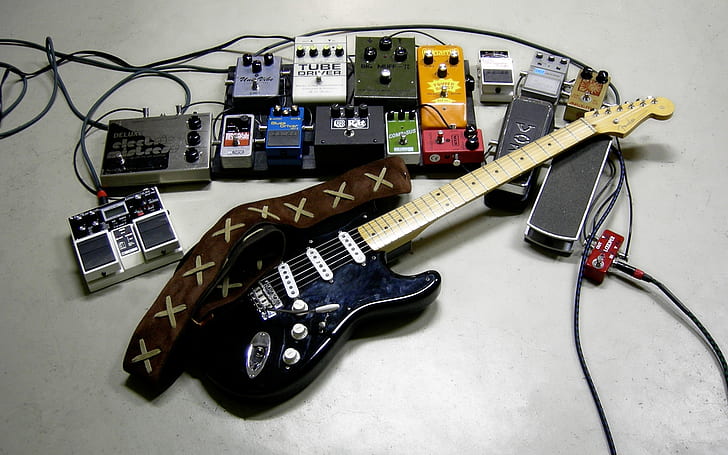
“That sound” could be your signature sound, or you could be trying to copy somebody else’s. It doesn’t really matter, the important thing lots of people just don’t get is that EVERYTHING to do with your guitar setup, affects your sound. From the wood your guitar is made from, the pickups, strings, cables, pedals, amplifiers to your playing technique, style and the calluses on your fingers. EVERYTHING has an effect, and finding your sound is an important part of being inspired to play.


I’m trying to impart this little nugget as a precursor to a set of blogs I’m planning to write about some of the gear dilemmas I’ve encountered, and what I've chosen to use, (and indeed, not use). I’d like to think they might help you to not make the same missteps I have, but to be honest, I think everybody probably needs to make some of their own mistakes about this kind of stuff. You’re on your path, I’m on mine, but informed opinion is better than expensive guesswork so, where does one start? I hear you <<both>> cry….


Well the unglamorous answer to that has already been mentioned, it’s probably strings. They’re relatively inexpensive and easily changed, (learn how to do it!) Basically heavier gauge strings give you a bigger, fuller sound, but can be slightly harder to fret or bend. Lighter strings for faster playing. Super hint for ukulele players : try swapping your standard “G” string for a low “G”, I swear that one thing could change your life ;-) Plectrums are another great starting point, what type to use, or whether to use one at all. I’m not trying to kid you that posh ukuleles, shiny guitars and amp stacks have arguably a bigger, or more immediate effect on your sound, but they definitely do have a bigger, more immediate effect on your wallet.


The first step then in embracing the mystery and adventure of discovering how far you can go with music is actually…..listening. Think about your playing and about what might be missing. Be critical, but not overly harsh. You might need to ask somebody how to achieve “that sound” or do a deep dive on youtube….. I’d like to refer you back to one of the first blogs I wrote last year in November….”Guitar Playing 101”.... which you might also consider a reasonable place to start thinking about some of this stuff in the right kind of way… However you go about it though, taking the time to try and get the best sound out of the instrument you’ve chosen is never a waste of time.


Do you have any similar tips to share, or a particular piece of gear you find particularly inspiring? Share it with us!


Tuesday, 2 January 2024

The Guitar / Ukulele Relationship

The Ukulele / Guitar Relationship

Tuesday January 2nd 2024

Firstly, and above all - a happy new year to you! Like me, hopefully, you’ll be looking to deepen your relationship with music this year, learn more, play more, listen more.


One way, as a player, that you can deepen that relationship I’ve learnt, is to try to play another instrument. Specifically, if your weapon of choice is the ukulele, you can actually already play some guitar, and vice versa. You might not have realised that. I know plenty of people who can play both, but have no real idea how the two instruments relate, so let’s deal with the “science bit”.


A ukulele (specifically the soprano, concert or tenor sizes) are basically a guitar with the first five frets chopped off, and the thickest two strings thrown in the bin. Binning those two bass strings is easy, chopping off the first five frets obviously isn’t, but fortunately sticking a capo on the fifth fret of a guitar achieves the same thing. Hey Presto! You’ve converted your guitar into a ukulele. A ukulele is strung five frets higher than a guitar, which in turn means that in order to play the same chord sound, (emphasis on "sound", i.e. tones, specific notes) you need to use a different chord shape.


Hopefully I don’t need to tell you that this picture is to help illustrate what I just said. DO NOT simply attempt to chop saw the end off of anyone’s guitar, to turn it into a ukulele. Always put safety goggles on first ;-) ……


You can think about this relationship both ways round. As a ukulele player, if you can get your hands on a second hand guitar, you can follow this suggestion and start to get used to playing a bigger instrument, without learning any new chord shapes. If you’re a guitar player, the next time you need to change your strings, just remove your bass “E” and “A” strings, put your capo on five and look up some ukulele chords. Try playing some songs you know using these new chord patterns. It’ll sound new, maybe even interesting. It’ll sound even better if you have a friend who can play the "normal" guitar chords whilst you play these new ones.


The astute amongst you may have noticed, or at least suspected, I’ve used a few phrases that are deliberately…… misleading.


The phrase “science bit” could also be read as “music theory”, which I know can sometimes have the result of people sticking their fingers in their ears and shouting “LA LA LA……” Tough. Music theory is good, I think, as long as it has a practical application to what you’re doing, and this is one of those times. “New chord patterns” is the another one, ukulele and guitar chord patterns are actually the same, albeit that ukulele chord shapes are truncated versions of guitar chord shapes, because you don’t have as many strings to worry about.


If all this is new to you, it might be raising some more questions that require a bit more explanation - that’s great! I’m going to continue this topic another time, but, if you have any burning questions that just can’t wait, email me, or ask me at a club night.


Record Time


This week, record time has nothing to do with this blog what-so-ever. I'm going to recommend you check out the album "Mother Road" by Grace Potter. It's a pretty candid, sometimes rude, kinda autobiographical, self help romp across the desert backroads of America. Fans of Tina Turner may approve.

Here's a link to a live version of the song "Ready Set Go" on youtube....
https://www.youtube.com/watch?v=mAsflXVXqZ0

Until next time!


That's it, I'm off...

  Friday March 1st 2024 Ok, it's official. This blog has now moved to... jonwh33ler.wixsite.com/blog Why don't you come on over and ...